 Great Lake T'ai Chi Ch'uan
Who We Are
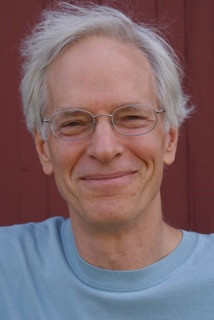
Mark Westcott is a senior student of Maggie Newman of New York City. Mark has been studying T'ai chi for 50 years. He has been teaching since 1982 at which time Maggie passed her Rochester school on to him. Mark has also studied extensively with Ben Lo, Liu Hsi Heng, Yuan Wei-ming and Lenzie Williams.
Mark administrates and is one of 6 co-teachers at the annual Finger Lakes Tai Chi Camp begun by Maggie Newman and continued on by her senior students.

Jean Zimmermann is a student of Maggie Newman and has practiced T'ai Chi for 28 years. She studied with Maggie in both NYC and Philadelphia. Jean has received
additional training through workshops and camps taught byBen Lo, Lenzie Williams, Yuan Wei-ming, Ed Young and Herman Kauz and sword fencing with Ken
VanSickleCertified to teach by Maggie Newman in 2004, Jean has been teaching in Rochester since relocating here in 2006.
One of 6 co-teachers at Maggie's Legacy Camp in the Finger Lakes, Jean also conducts occasional Workshops in Rochester with invitees coming from NY, Philadelphia and DC.
Our T'ai Chi Lineage

Dedicated to the
continuous teaching of
Professor Cheng Man ch'ing's
Yang Style Short Form
in Rochester NY
Since 1982
 Professor Cheng Man Ch'ing
Professor Cheng Man Ch'ing came to New York in the sixties and was one of the first to teach t'ai chi openly to non-Chinese students. Since then his Yang Short Form has become one of the most popular forms of T'ai chi world-wide. We teach the form as it was faithfully conveyed to us by Maggie Newman, an internationally respected senior student of Professor Cheng.
 Maggie Newman
Maggie Newman is one of Professor Cheng's six original students in New York City. She studied with him from 1964 until his death in 1975. She is an internationally respected teacher of T'ai chi and has been for over 50 years. Maggie established classes in Philadelphia, New York and Rochester. The Rochester school was turned over to Mark in 1982 and has been run continuously as Great Lake T'ai Chi Ch'uan ever since.
We are deeply saddened to share that our beloved teacher, Maggie Newman, passed away peacefully in her sleep October 8, 2025 at the age of 101.
Maggie was a remarkable soul — a masterful Tai Chi teacher, a professional dancer, a black belt in Aikido, and a devoted practitioner of Zen and Kabuki. Her grace, strength, and wisdom touched each of us in profound ways. She was a true treasure — both fierce and gentle, powerful and deeply compassionate.
She leaves behind a wide and devoted community of students and friends who were inspired by her presence, her teaching, and the way she embodied her art.
She will be deeply missed by all who knew her.
In Memory of Maggie Newman
(1924 - 2025)
Margaret J. Newman, whose life traced a rare and graceful arc from modern dance to Kabuki to T’ai Chi, passed away on October 8, 2025. She was a singular artist and teacher, weaving together traditions of East and West into a lifetime of movement, discipline, and deep spirit.
Born in Lanett, Alabama, Maggie’s early fascination with form led her first to sports, then to dance. After studies at the University of Alabama and summers at Jacob’s Pillow, she moved to New York in 1950, where she immersed herself in the Katherine Dunham School of Dance, the School of American Ballet, the Metropolitan Opera Ballet School, and the Louis Johnson Company. She performed tirelessly, appearing in modern dance concerts, nightclubs, and on television, and toured internationally with the Paul Taylor Dance Company. Dance critics and colleagues alike praised her as a performer of versatility, rigor, and elegance.
Yet Maggie’s genius lay not only in performance, but in her ceaseless curiosity. In the early 1960s, her path turned toward Asia’s great embodied arts. She studied meditation with Maharishi Mahesh Yogi and Zen master Nakagawa Sōen Rōshi, and trained in martial disciplines including karate and aikido, earning her black belt under Sensei Yamada and Master KōichiTōhei. For fifty years she also devoted herself to Japanese classical Kabuki dance, a practice that enriched her understanding of theater, gesture, and presence.
The deepest of these lifelong studies began in 1964, when Maggie met Professor Cheng Man-ch’ing, the renowned Yang-style T’ai Chi master. She became one of his six senior students in New York, entrusted with carrying forward his teaching. Maggie went on to nurture learners in Rochester, Philadelphia, New York City, and beyond, teaching workshops, camps, and weekly classes for over half a century. She was widely recognized as one of the pillars of Professor Cheng’s lineage in America.
Maggie’s teaching was marked by humility and insight. She often said the teacher’s task was “not to squelch the student’s spirit,” but to create a structure in which discipline and spontaneity could meet. Students recall her precision of eye, her warmth, and her quiet humor—whether guiding them through the subtleties of push-hands, demonstrating the sword, or encouraging them to “stay awake” within the form. For Maggie, T’ai Chi was never just technique; it was the daily practice of discovering one’s body, mind, and heart anew.
In every art she touched—dance, Kabuki, martial arts, calligraphy, painting, and above all, T’ai Chi—Maggie Newman embodied balance, refinement, and openness. She carried traditions forward while leaving space for others to find their own way within them. Her students, colleagues, and countless admirers will remember her not only as a master, but as a rare presence: grounded yet light, disciplined yet free, precise yet compassionate.
Her legacy endures in the bodies, minds, and spirits of those she knew and taught.
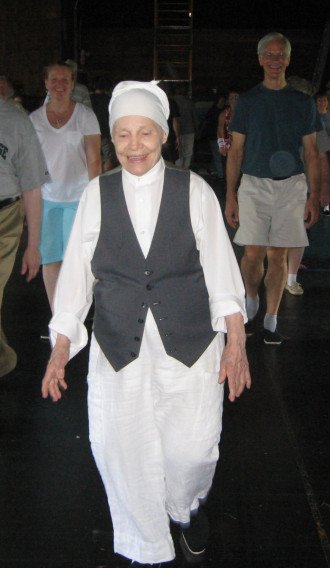 Maggie Newman at Finger Lakes T'ai Chi Camp with Jean & Mark

Five Basic Tai Chi Principles:
Relax
Body Upright
Separation of Weight
Move from the Waist
Beautiful Lady's Wrist
"The practice of Tai Chi is about discovering yourself. It's about forces of the world - both natural and unnatural and how one relates to them. It's about focus and about balance. It's the understanding that things change and knowing how to stay centered throughout the changes."
- Ed Young
 Print
Print 